
Paul Feig Net Worth 2026: How The Housemaid Made Him Hollywood's Smartest Bet
What is Paul Feig net worth in 2026?
Paul Feig has an estimated net worth of $30 million as of 2026. He is an American director, producer, screenwriter, and entrepreneur best known for directing Bridesmaids (2011), The Heat (2013), Spy (2015), and The Housemaid (2025). His films have collectively grossed over $1.4 billion at the global box office. His most recent film, The Housemaid, earned $401.7 million on a $35 million budget — an 11.5× return that made it Lionsgate’s highest-grossing film in years. Beyond directing, he earns income through his production company Feigco Entertainment, a Lionsgate first-look deal, his Artingstall’s Brilliant London Dry Gin brand, and his real estate portfolio.
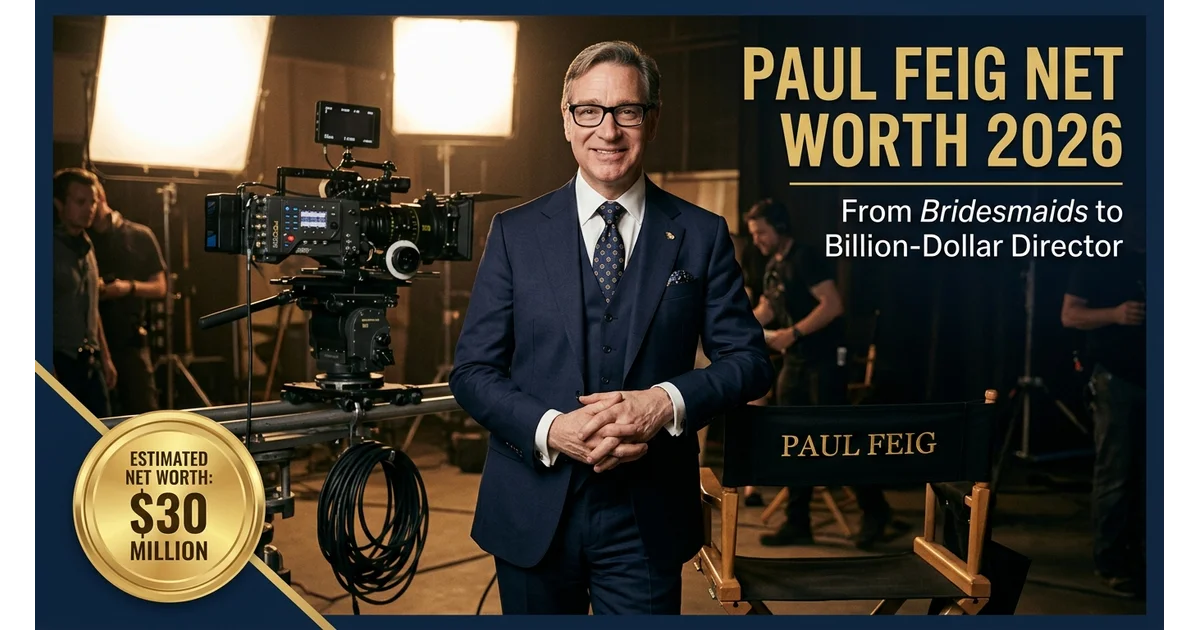
Paul Feig — Quick Profile
| Detail | Information |
|---|---|
| Full Name | Paul Samuel Feig |
| Born | September 17, 1962 — Mount Clemens, Michigan |
| Age (2026) | 63 Years Old |
| Profession | Director, Producer, Screenwriter, Author, Entrepreneur |
| Estimated Net Worth | $30 Million (2026) |
| Career Box Office Total | $1.4 Billion+ |
| Production Company | Feigco Entertainment |
| Studio Deal | First-Look Deal with Lionsgate (Signed April 2025) |
| Business Venture | Artingstall's Brilliant London Dry Gin |
| Married | Laurie Karon (Since September 23, 1994) |
| Based | Burbank, California |
Introduction
Paul Feig’s most expensive professional habit is wearing bespoke suits to work every day. He started at age eight, inspired by Groucho Marx, and has not stopped. His suits from Savile Row’s Anderson & Sheppard cost thousands of pounds each. He owns dozens of them. He calls it a management philosophy.
But the more interesting number is this: in 2025, he directed a film on a $35 million budget that earned $401.7 million at the global box office. That is an 11.5-to-1 return on investment — the kind of figure that makes studio executives forget about Ghostbusters, forgive the occasional flop, and offer you a first-look deal.
That is exactly what Lionsgate did in April 2025.
Paul Feig’s estimated $30 million net worth does not fully capture what he has built. Directors who consistently deliver profitable mid-budget films in an era where mid-budget films are supposed to be dead are worth considerably more to a studio than their personal balance sheet suggests. His real asset is not the $30 million. It is the fact that Lionsgate chairs describe him publicly as one of the best storytellers in the business — and then back that statement with contracts.
Early Life: Michigan to Hollywood via Game Show
Feig grew up in Mount Clemens, Michigan, the only child of Sanford Feig (who ran a hardware supply store) and Elaine (a telephone operator). His father was born Jewish but converted to Christian Science; Paul was raised in that faith, a fact he has spoken about in interviews as part of the complex identity he navigated growing up.
He knew he wanted to perform early. By age 15 he was doing stand-up at local comedy clubs. After a year at Wayne State University, he made the decision most Michigan kids with Hollywood ambitions make but rarely follow through on: he moved to Los Angeles, enrolled at USC’s film school, and began working as a tour guide at Universal Studios to pay his bills.
The pivotal moment came in 1985 — not from an audition or a breakthrough role, but from a game show. He competed on Pyramid and walked away with $25,000. The money was enough to fund a stand-up comedy tour and, critically, to create the mental breathing room to focus entirely on his career rather than survival income. He has said in multiple interviews that none of what followed would have been possible without that win.
That particular origin story — comedian wins prize money, uses it to pursue art, eventually becomes one of Hollywood’s most commercially reliable directors — is one of the entertainment industry’s more improbable straight lines.
Career: 15 Projects, $1.4 Billion, and One Central Thesis
Feig’s career has been defined by a single conviction he has held since Bridesmaids: female-led films are commercial gold, and the industry’s reluctance to greenlight them is a market inefficiency he can exploit.
He has been right every single time the evidence has come in.
Here are his 13 most significant projects, with the financial context that makes each one meaningful:
1. Stand-Up Comedy (1985–1990s)
Earnings: Unknown — modest Significance: Foundation income; launched his LA career
Not a lucrative phase, but the discipline of performing material in front of audiences who don’t have to laugh shapes every decision he makes as a director. He has said his stand-up background taught him how quickly an audience tells you whether something is working.
2. Acting — The Facts of Life, Sabrina the Teenage Witch, Heavyweights (1988–2005)
Earnings: Low to mid five figures per appearance Significance: Paid the bills; built the industry relationships
His most lasting acting credit is Mr. Pool in Sabrina the Teenage Witch, a recurring role he held while simultaneously writing and developing Freaks and Geeks. The acting career never generated significant wealth but kept him visible in an industry where visibility is currency.
3. Freaks and Geeks (1999–2000) — NBC
Earnings: Writer/creator fee — estimated $500K–$1M total Significance: Cult classic; launched James Franco, Seth Rogen, Jason Segel
Co-created with Judd Apatow, Freaks and Geeks lasted one season before NBC cancelled it. Time Magazine subsequently named it one of the 100 Greatest TV Shows of All Time. It earned Feig two Emmy nominations for writing.
The financial return was limited. The career return was enormous: it established him as a writer with genuine voice and put him in a working relationship with Apatow that would eventually produce Bridesmaids.
4. Television Directing — The Office, 30 Rock, Parks and Recreation (2004–2011)
Earnings: $50,000–$150,000 per episode estimated Significance: Built his reputation as a director who gets performances
This is the phase of his career that most profiles underweight. Feig directed key episodes of three of the most acclaimed comedies of the 2000s. The skill he was developing was not just comedy timing — it was how to collaborate with strong performers and get something real from ensemble casts under time and budget pressure. That skill transferred directly to Bridesmaids.
5. Bridesmaids (2011) — Universal
Budget: $32.5 million | Box Office: $324.8 million | ROI: 10× Significance: Career-defining; changed Hollywood’s calculus on female comedies
He was told it would fail. He made it anyway. The film earned Golden Globe and Academy Award nominations (Kristen Wiig and Annie Mumolo for Original Screenplay), and grossed $324.8 million worldwide — ten times its budget. In 2011, that number proved definitively that the conventional industry wisdom about female-led comedies was wrong.
His directing fee for a film of this size would have been approximately $2–$4 million. More significantly, it established his market rate for everything that followed.
6. The Heat (2013) — Fox
Budget: $43 million | Box Office: ~$229 million | ROI: 5.3× Significance: First collaboration with Melissa McCarthy in a lead role
Sandra Bullock and Melissa McCarthy in an odd-couple buddy cop comedy. Straightforward concept, executed with enough specificity that it grossed five times its budget. Feig’s fee by this point would have been approximately $4–$6 million.
7. Spy (2015) — Fox
Budget: $65 million | Box Office: ~$235 million | ROI: 3.6× Significance: McCarthy + Jason Statham; two Golden Globe nominations
His third consecutive profitable female-led film. The movie’s success further entrenched his reputation as the director studios call when they want a female-driven property to work.
8. Ghostbusters (2016) — Sony
Budget: $144 million | Box Office: ~$229 million | ROI: 1.6× (marginal) Director fee: $10 million (confirmed by Celebrity Net Worth) Significance: His biggest fee; marginal commercial result; ended major studio relationship another example of how misogynistic backlash has direct financial consequences for entertainment careers
The Ghostbusters reboot is the outlier in his filmography. It was profitable on paper but not profitable enough to justify its production and marketing costs. Sony did not work with him again. He has been characteristically candid about this outcome and the misogynistic online backlash the film received before it was even released.
His $10 million directing fee, however, was his largest single payday as a director — a figure that anchors his net worth estimate significantly.
9. A Simple Favor (2018) — Lionsgate
Budget: $20 million | Box Office: $97.6 million | ROI: 4.9× Significance: Pivotal shift into thriller genre; Blake Lively career moment
After Ghostbusters, Feig moved away from major studio comedy and into female-driven psychological thriller with A Simple Favor. The film found a massive second life on streaming, regularly topping Netflix charts years after its theatrical run. It became the blueprint for The Housemaid.
10. Last Christmas (2019) — Universal
Budget: ~$25 million | Box Office: $123.4 million | ROI: 4.9× Significance: Proved the pivot into drama/comedy hybrid was sustainable
Emma Thompson scripted and co-starred. Emilia Clarke led. The film earned five times its production costs — a quietly impressive result that often gets overlooked in his filmography because it sits between A Simple Favor and the pandemic.
11. Another Simple Favor (2025) — Amazon Prime
Budget: Undisclosed | Viewership: 51.5 million views (first few weeks) Significance: Biggest streaming debut for a thriller per Amazon insiders
Feig wanted a theatrical release. Amazon pushed for streaming. The film broke Amazon’s viewership records for a thriller. The 51.5 million view figure represents an enormous audience — and the streaming backend that comes with that level of engagement, while not public, is not insignificant.
12. The Housemaid (2025) — Lionsgate
Budget: $35 million | Box Office: $401.7 million | ROI: 11.5× Significance: His highest-grossing film ever; triggered Lionsgate first-look deal
The Housemaid is the film that reframes his entire career. On the weekend of January 23–25, 2026, it passed Bridesmaids to become his highest-grossing film ever. It then crossed $300 million, $350 million, and ultimately $401.7 million — making it the fourth-biggest non-sequel/non-franchise film of its era.
Sydney Sweeney and Amanda Seyfried starred. The film cost $35 million to produce and earned back 11.5 times that figure. Lionsgate chair Adam Fogelson called Feig’s sense of character and story “among the best in the business.”
His producing credit on this film, via Feigco Entertainment, means he participates in backend profits — not just a director’s fee.
13. The Housemaid's Secret (2027 — in pre-production)
Budget: TBD | Box Office: TBD Significance: First film under the Lionsgate first-look deal
Shooting is expected in 2026 for a 2027 release. Sydney Sweeney is confirmed to return. Amanda Seyfried’s character was not in the source novel but has been discussed as a potential addition. Given the original film’s $401.7 million performance, this sequel enters development as one of Lionsgate’s highest-priority projects.
Complete Film Box Office ROI Table

| Film | Year | Budget | Box Office | ROI |
|---|---|---|---|---|
| Bridesmaids | 2011 | $32.5M | $324.8M | 10.0× |
| The Heat | 2013 | $43M | $229M | 5.3× |
| Spy | 2015 | $65M | $235M | 3.6× |
| Ghostbusters | 2016 | $144M | $229M | 1.6× |
| A Simple Favor | 2018 | $20M | $97.6M | 4.9× |
| Last Christmas | 2019 | $25M | $123.4M | 4.9× |
| The Housemaid | 2025 | $35M | $401.7M | 11.5× |
| Career Total | — | — | $1.4B+ | — |
The pattern: Every film except Ghostbusters returned at least 3.6× its production cost. Three films returned 5× or more. The Housemaid returned 11.5× — the best result of his career on the smallest budget outside Bridesmaids.
Directors Comparison Table
| Director | Estimated Net Worth | Known For | Career Box Office |
|---|---|---|---|
| Christopher Nolan | ~$250M | Inception, Oppenheimer | $5.8B+ |
| Judd Apatow | ~$150M | Knocked Up, Superbad (Producer) | $1.5B+ |
| James Cameron | ~$700M | Avatar, Titanic | $10B+ |
| Paul Feig | ~$30M | Bridesmaids, The Housemaid | $1.4B+ |
| Patty Jenkins | ~$30M | Wonder Woman | $0.8B+ |
| Adam McKay | ~$40M | The Big Short, Succession | $0.8B+ |
| Lee Daniels | ~$30M | Precious, Empire | $0.4B+ |
Key takeaway: Feig’s $30 million net worth is modest relative to his career box office total. It reflects the reality that directors rarely participate in full backend profits the way major stars do — another director who built a career on a consistent creative vision rather than chasing franchise money. and that his best-earning years in terms of backend may still be ahead of him through the Lionsgate deal and The Housemaid sequel.
How Paul Feig Makes Money in 2026
1. Directing Fees — The Foundation
Feig’s per-film directing fee scaled from approximately $2–$4 million for Bridesmaids to $10 million for Ghostbusters. Post-The Housemaid, his market rate has almost certainly re-established itself at the $8–$15 million range per project. The Lionsgate first-look deal provides both guaranteed work and negotiating leverage with other studios.
2. Feigco Entertainment — The Multiplier
His production company, Feigco Entertainment (run with partner Laura Fischer), gives him a producer credit on his own films and any films developed under the Lionsgate deal. Producing credits on a $401.7 million film generate a very different income than a flat directing fee. for context on how production company equity differs from salary-based wealth. The backend participation on The Housemaid alone may have materially increased his net worth in 2025–26.
3. Lionsgate First-Look Deal — The Security
Announced at CinemaCon in April 2025, this deal means Lionsgate has first option on every project Feig develops through Feigco Entertainment. The financial structure of first-look deals typically includes an annual development fund (often $1–3 million per year) plus production fees when projects are greenlit. It is not his biggest income source but it provides a guaranteed annual income floor with significant upside.
4. Artingstall's Brilliant London Dry Gin — The Venture
Feig spent years developing his own gin, eventually partnering with the Minhas distillery in Canada to produce Artingstall’s Brilliant London Dry Gin. He specifically engineered it to be “approachable” for American drinkers by reducing the heavy juniper profile common in London dry gins. He wrote a companion cocktail book, Cocktail Time!, and launched his brand during the pandemic via his popular Instagram series “Quarantine Cocktail Time.”
Premium boutique gin brands at his volume generate modest but consistent income — likely $200,000–$600,000 annually depending on distribution reach. More importantly, it demonstrates his ability to build a consumer brand around his personal identity — a skill that has value beyond the direct revenue.
5. Real Estate Portfolio
His current holdings:
| Property | Location | Value / Details |
|---|---|---|
| Primary Residence | Burbank, California | Bought in 1998 for $632,000 (Estimated $2M+ Today) |
| Palm Springs Home | California | Purchased in July 2024 for $2.6 Million |
| Manhattan Apartment | New York | Purchased for Approximately $3 Million in 2017; Listed for $3.3 Million in 2024 |
His real estate strategy reflects his lifestyle: Burbank as a working base (near studios), New York for industry events, Palm Springs as leisure. The Manhattan listing — sold or in progress — would return his original investment with modest appreciation.
Annual Income Estimate: 2026

| Source | Estimated Annual Income |
|---|---|
| Directing / Producing Fees | $8M–$15M (Per Project Year) |
| Feigco Backend (The Housemaid) | $2M–$5M (Ongoing) |
| Lionsgate Development Fund | $1M–$3M |
| Artingstall's Gin Business | $200K–$600K |
| Book Royalties | $50K–$150K |
| Real Estate Income | $100K–$300K |
| Annual Total (Project Year) | $11M–$24M |
The Suits: More Than a Quirk
No profile of Paul Feig is complete without addressing what has become his most recognizable personal brand: the suits.
He began wearing suits daily at age eight, inspired by old Hollywood films and Groucho Marx. He has maintained this practice for 55 years, ordering bespoke made-to-measure suits from Savile Row tailors including Anderson & Sheppard and Huntsman. He owns “hundreds” by his own count.
The financial logic — to the extent personal aesthetics have financial logic — is threefold. First, it functions as a professional statement that he takes his role as director seriously (“the captain of the ship,” in his phrasing). Second, he invented what he calls the “Tailoring Diet”: because his suits are made to exact measurements, any weight gain is immediately evident in fit. It functions as an involuntary health monitor. Third, the suits have become a genuine personal brand signal — in an industry full of directors in jeans and fleece, being the guy in the suit is a memorable distinction.
Richard Mille watches — ultra-luxury Swiss timepieces starting at $150,000 — are his stated “grail” purchase. Whether he has acquired any is not public.
Controversies
The Ghostbusters reboot cast an all-female lead group: Melissa McCarthy, Kristen Wiig, Kate McKinnon, and Leslie Jones. Before the film released, it became a focal point for coordinated online misogyny — an episode that became a case study in how internet harassment campaigns target female-led entertainment. Feig handled it publicly and directly, refusing to distance himself from the film or its cast.
The film performed adequately by normal standards ($229 million on a $144 million production budget) but Sony’s marketing investment meant the overall return was insufficient for a sequel. No major studio has worked with him since — a form of soft industry penalty that he has noted publicly.
His response was to take A Simple Favor to Lionsgate, then The Housemaid. The results suggest the penalty was the studios’ loss.
Frequently Asked Questions
What is Paul Feig net worth in 2026?
Paul Feig’s net worth is estimated at $30 million in 2026. He has earned this through directing fees (including a $10 million fee for Ghostbusters), producing income through Feigco Entertainment, and business ventures including his Artingstall’s gin brand and real estate holdings.
What is Paul Feig's most successful movie?
The Housemaid (2025), starring Sydney Sweeney and Amanda Seyfried, is his most successful film by box office — earning $401.7 million worldwide on a $35 million budget, an 11.5× return on investment. It surpassed Bridesmaids ($324.8 million) as his career-highest-grossing film in January 2026.
How much did Paul Feig earn from Ghostbusters?
He was paid $10 million as director of the 2016 Ghostbusters reboot, plus a percentage of profits. This remains his largest confirmed single-project directing fee. The film earned $229 million at the box office on a $144 million production budget — technically profitable but not enough to justify its costs fully.
What is Paul Feig's total career box office?
His films as director have collectively earned over $1.4 billion at the global box office. His five highest-grossing films as director all returned at least 3.6 times their production budget, with The Housemaid and Bridesmaids both returning 10× or more.
What is the Lionsgate first-look deal?
Announced at CinemaCon in April 2025, Feig signed a first-look film deal with
Lionsgate through his production company Feigco Entertainment. The deal means Lionsgate gets first right of refusal on any project Feig develops. It provides guaranteed annual development funding and production fees, and positions him as one of Lionsgate’s primary filmmaker partners.
Does Paul Feig own a gin company?
Yes. He created Artingstall’s Brilliant London Dry Gin, partnering with the Minhas distillery in Canada. He engineered the gin to be more approachable for American drinkers than traditional London dry gins. He also wrote a companion cocktail book, Cocktail Time!, and launched a popular Instagram series during the pandemic called “Quarantine Cocktail Time.”
What is Paul Feig working on in 2026?
He is in pre-production on The Housemaid’s Secret, the sequel to The Housemaid, which is expected to begin filming in 2026 for a 2027 release. Sydney Sweeney is confirmed to return. He is also developing new projects through Feigco Entertainment under his Lionsgate first-look deal.
Why did Paul Feig win a game show?
In 1985, Feig competed on Pyramid and won $25,000. He used the money to fund a stand-up comedy tour and, more importantly, to focus on his career full-time rather than maintaining survival income. He has credited the game show win as a pivotal moment in his career.
Who is Paul Feig's wife?
Paul Feig married Laurie Karon on September 23, 1994. They have been married for over 30 years and live in Burbank, California. Laurie is a producer who has worked on several of his projects.
What happened to Freaks and Geeks?
Freaks and Geeks, which Feig co-created with Judd Apatow based on his own high school experiences, aired for one season on NBC (1999–2000) before being cancelled. It has since become a cult classic. Time Magazine included it on its list of 100 Greatest TV Shows of All Time. The show launched the careers of James Franco, Seth Rogen, Jason Segel, and Linda Cardellini. Feig received two Emmy Award nominations for his writing.
Conclusion
Paul Feig’s $30 million net worth is a number that simultaneously undersells and accurately describes him.
It undersells him because it doesn’t account for what The Housemaid‘s backend participation means for his finances going forward, or what a first-look deal with a major studio is worth over three to five years of active development. A director who can deliver 11.5-to-1 returns on a $35 million film is not a $30 million asset to a studio. He is considerably more valuable than that.
It accurately describes him because he has never been driven by the accumulation mathematics that defines many Hollywood careers. He wears the expensive suits. He makes the bespoke gin. He obsesses over watches. He starts every production by dressing as though he is the captain of a very expensive ship.
The suit is not a luxury. It is the point.
And the films — from the comedy about women who behave badly at a wedding to the psychological thriller about a maid who isn’t what she seems — are what he uses to pay for a very long, very well-dressed career.
At 63, with a studio deal, a sequel in pre-production, and his highest-grossing film behind him, the financial arc is clearly still ascending.