
Athlete Contracts Explained: Why That "$250 Million Deal" Almost Never Means $250 Million
What's the difference between "total contract value" and "guaranteed money"?
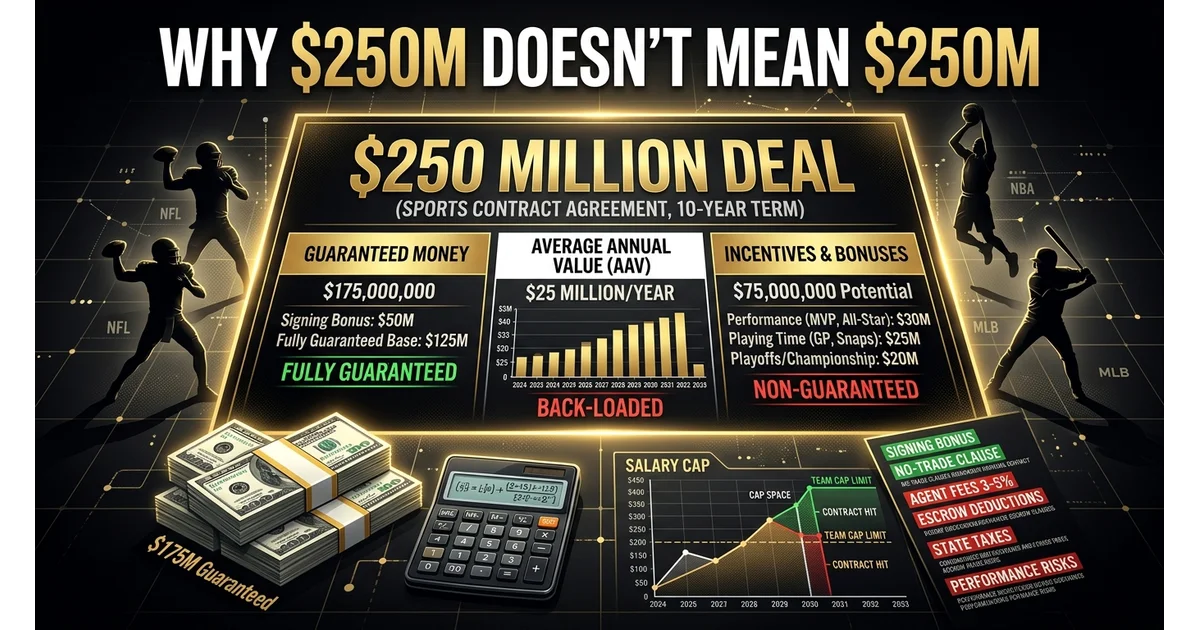
Total contract value is the maximum a player could earn if every year of the deal plays out exactly as written, including incentives and options. Guaranteed money is what the player is contractually owed no matter what — even if they’re cut, injured, or perform poorly. In the NFL, these two numbers are often very different. In the NBA, they’re almost always the same, since nearly all NBA contracts are fully guaranteed.
Quick Comparison: How Guarantees Work By League
| League | Are Contracts Fully Guaranteed? | Key Exception |
|---|---|---|
| NBA | Yes, almost always | Two-way (G-League) deals, some minimum salaries |
| MLB | Yes, almost always | Rare opt-out or option-year structures |
| NFL | No — guarantees are partial and negotiated | Deshaun Watson’s 2022 deal is the only fully guaranteed NFL contract to date |
Why This Confusion Happens
Every time a major athlete signs a new deal, headlines report one giant number — “$250 million extension,” “$450 million max contract.” That number is real in the sense that it’s the contract’s stated ceiling. But it’s rarely the number that ends up in the player’s bank account, and the gap between the headline and the actual guaranteed money can be enormous, especially in the NFL.
This isn’t sloppy reporting — it’s a structural difference in how each league negotiates and writes contracts. Understanding it changes how you should read every “biggest contract in sports history” headline going forward.
The NFL: Why Almost Nothing Is Fully Guaranteed
The NFL is the clearest example of headline-vs-reality. The multiple sources including Russell Street Report and SportsOrca, most NFL contracts only guarantee a portion of their total value — typically the signing bonus and sometimes a base salary tranche. The rest is conditional, often locked in only if the player is still on the roster by a specific date in a future year.
There is exactly one fully guaranteed contract in NFL history: Deshaun Watson’s five-year, $230 million deal with the Cleveland Browns, signed in 2022. Every other quarterback megadeal since then — including Patrick Mahomes’ extension — has guaranteed money structured in stages, not paid out as one lump promise.
Why doesn’t the NFL do full guarantees like other leagues? The NFL operates under a hard salary cap — every team is bound to the same spending limit regardless of ownership wealth. Fully guaranteeing big contracts would make it far riskier for teams to commit to multi-year deals, since an injury could lock in payments for a player no longer contributing on the field.
Key terms to know, per Yardbarker:
- AAV (Average Annual Value): Total contract value divided by number of years. This is the number most often reported as a player’s “salary” — but it can be misleading, since pay is rarely distributed evenly across the deal.
- Offset language: A clause that can reduce what a team owes a cut player if he signs elsewhere — meaning a “guaranteed” number can shrink in practice.
- Void years: Artificial extra years added to a contract purely to spread out a signing bonus’s cap impact, even though the player is never expected to play those years.

The NBA: Nearly Everything Is Guaranteed
The NBA works almost the opposite way. Nearly all NBA contracts are fully guaranteed — the only common exceptions are two-way contracts (players splitting time between the NBA and G-League) and certain minimum-salary situations.
This is why, when a player signs a “$224 million extension” in the NBA, that figure is much closer to what they’ll actually receive than the equivalent NFL headline number. It’s also why NBA free agency moves so differently — teams know exactly what they’re committing to, with far less of the conditional language that defines NFL deals.
A useful real-world comparison, via CBS Sports: when Patrick Mahomes and Giannis Antetokounmpo signed major extensions around the same period, Mahomes’ deal had a higher total figure — but Antetokounmpo’s fully guaranteed NBA structure meant his money was far more secure year to year, even at a lower headline number.
Why You'll See Different Numbers for the Same Contract
This is the exact pattern that creates confusion across sports media — and even celebrity net worth sites that cover athletes. A single contract can be legitimately reported several different ways:
- Total maximum value — every dollar possible, including unlikely incentive triggers
- Guaranteed value at signing — what’s locked in immediately
- Practical guarantee — what becomes fully secured once certain rolling-guarantee dates pass
- AAV — the total divided evenly across the years, which almost never matches actual year-by-year pay
None of these numbers is “wrong” — they’re answering different questions. The mistake is treating any single one of them as the complete picture, or assuming all four will be identical.
For a real example of exactly this pattern, see how Anthony Edwards contract was reported at three different total figures — $224.6 million, $244.6 million, and $260 million — across otherwise reliable sources, depending on which of these measurements each one was citing.

How One Contract Got Reported Three Different Ways
It’s common for a single athlete’s contract to be cited at three or more different total values across different outlets within the same year — not because anyone is lying, but because each source may be citing the maximum potential value (including performance-based escalators), the guaranteed-at-signing figure, or a midpoint estimate that blends the two. When researching any athlete’s earnings, the most reliable approach is to check whether a cited figure specifies “guaranteed,” “maximum,” or “average annual value” — and to treat any number without that distinction as incomplete.
What This Means When You're Reading Athlete Net Worth Figures
The next time you see a headline like “[Athlete] Signs $250 Million Deal,” here’s the practical takeaway:
- If it’s an NBA or MLB contract: That number is close to what they’ll actually receive.
- If it’s an NFL contract: Look for the word “guaranteed” specifically. If it just says “contract worth,” assume a meaningful chunk of that total is conditional.
- AAV is a planning tool, not a paycheck. It tells you how a contract affects a team’s cap, not how the player is actually paid year to year.
Frequently Asked Questions
What does "fully guaranteed" mean in sports contracts?
It means the money is protected regardless of injury, performance, or being released from the team — the player is owed that amount no matter what happens.
Why does the NFL have so few fully guaranteed contracts?
Because of the league’s hard salary cap. Fully guaranteeing large contracts would make it significantly riskier for teams to commit multi-year money to players, particularly given injury risk.
Is AAV the same as a player's actual salary?
No. AAV (Average Annual Value) is the total contract value divided evenly across its years for accounting and salary cap purposes. A player’s actual year-to-year pay is often front-loaded or back-loaded differently.
Which sports league guarantees the most money?
The NBA and MLB guarantee nearly all contract value as standard practice. The NFL is the outlier among major U.S. sports leagues, with only one fully guaranteed contract in its history (Deshaun Watson, 2022).
What is a void year in an NFL contract?
An artificial extra year added to a contract purely to spread out a signing bonus’s cap impact over more seasons — the player is never actually expected to play in that final year.
Why do different websites report different total values for the same athlete's contract?
Because “total value,” “guaranteed money,” and “AAV” are three different, legitimate ways to describe a contract, and sources don’t always specify which one they’re citing.
Conclusion
Every major sports contract headline is technically true and often still misleading — not because of bad reporting, but because “total value,” “guaranteed money,” and “AAV” describe three different things that happen to share a dollar sign. The NBA and MLB make this simpler by guaranteeing nearly everything upfront. The NFL, bound by a hard salary cap, almost never does — which is exactly why the same quarterback’s contract can be reported as “$450 million” in one headline and “$140 million guaranteed” in another, with neither outlet being wrong.