
Spike Lee Net Worth 2026: The $60M Empire Behind the Director's Chair
What is Spike Lee net worth in 2026?
Spike Lee has an estimated net worth of $60–75 million as of 2026. His wealth comes from four decades of film directing and producing through his company 40 Acres and a Mule Filmworks, a long-running Nike commercial partnership that began in 1987, Manhattan and Brooklyn real estate valued in the tens of millions, his tenured professor salary at NYU Tisch School of the Arts, and a catalog of films that continues to generate royalties and licensing income. His biggest single commercial film — Inside Man (2006) — grossed $184 million worldwide. His first Oscar came in 2019 for BlacKkKlansman.
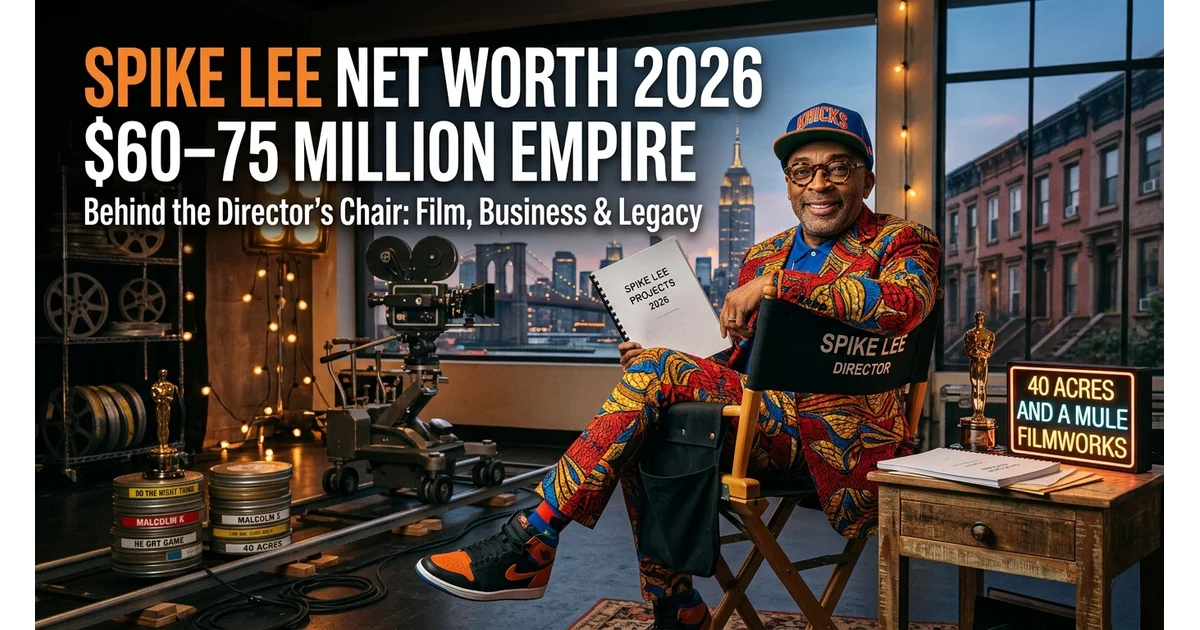
Spike Lee — Quick Profile
| Detail | Information |
|---|---|
| Full Name | Shelton Jackson Lee |
| Born | March 20, 1957 — Atlanta, Georgia |
| Age (2026) | 69 years old |
| Education | Morehouse College + NYU Tisch MFA |
| Profession | Director, Writer, Producer, Actor, Professor |
| Production Company | 40 Acres and a Mule Filmworks |
| Net Worth (2026) | $60–75 million |
| First Oscar | BlacKkKlansman — Best Adapted Screenplay (2019) |
| NYU Role | Artistic Director, Graduate Film Program (since 2002) |
| Famous Brand | Nike / Air Jordan (partnership since 1987) |
Introduction
Spike Lee never waited for Hollywood’s permission. When the industry ignored Black filmmakers in the 1980s, he borrowed money from friends, shot a film in 12 days on a shoestring budget, and turned it into a $7 million hit. That stubborn independence — creative and financial — is exactly how he built a fortune estimated at $60–75 million today.
But the number alone doesn’t tell the full story. Lee’s wealth is spread across four decades of films, a long-running Nike partnership, Manhattan real estate worth tens of millions, and a production company he still owns outright. For a filmmaker who started with almost nothing, that’s not just success — it’s a masterclass in staying in control of your own career.
Early Life: Brooklyn as Foundation
Born Shelton Jackson Lee in Atlanta in 1957, he was nicknamed “Spike” by his mother Jacqueline — a teacher who kept the house full of books on Black art and literature. His father Bill Lee was a jazz bassist and composer who showed him that creative work could sustain a life, if not always a fortune.
When the family relocated to Brooklyn’s Fort Greene neighborhood, the two threads — his mother’s literary intensity and his father’s creative independence — fused into something that would eventually produce one of American cinema’s most distinct voices.
He attended Morehouse College in Atlanta for his undergraduate degree in Mass Communication, graduating in 1979. He then enrolled at NYU’s Tisch School of the Arts, where his student thesis film Joe’s Bed-Stuy Barbershop: We Cut Heads won a Student Academy Award in 1983 — the first student film ever selected for the New Directors/New Films series at Lincoln Center and MoMA. That level of recognition before a professional debut is genuinely unusual, and it established the critical vocabulary that his career would spend the next four decades fulfilling.
The financial implications of that NYU credential compound over time. Lee has been associated with Tisch for more than four decades now — first as a student, then as a visiting professor, and since 2002 as the Artistic Director of the Graduate Film Program. That position carries a salary, institutional prestige, and a pipeline to the next generation of filmmakers who will cite his influence and occasionally hire him.
Career Earnings: 13 Films That Built $60 Million
1. She's Gotta Have It (1986)
Budget: $175,000 (raised from grants and family loans) Box office: $7.1 million Return: 40:1 Director’s earnings: $500,000–$1 million (backend points) Why it matters: This is the origin of everything. The 40:1 return on investment — from $175K to $7.1M — was one of the most remarkable first-film performances in American independent cinema. It did not just launch his career. It proved a specific financial thesis: that authentic Black stories, made with creative control and minimal studio interference, could generate extraordinary commercial returns. Every studio wanted him after this. the same year Lee made his debut, another figure was laying groundwork for a different kind of lasting cultural and financial legacy. He went to Universal for his next film, which is exactly the leverage a $7M indie hit creates.
2. School Daze (1988) — Universal Pictures
Budget: $6.5 million Box office: $14.5 million Director’s fee (est.): $500,000–$1 million Why it matters: His first studio film. Moving from an independent $175K budget to a $6.5M Universal production in two years is a financial trajectory that rarely happens that cleanly. The studio deal also meant his fee was now a separate line item from the film’s performance — guaranteed income regardless of box office.
3. Do the Right Thing (1989) — Universal Pictures
Budget: $6.5 million Box office: $37.3 million Director’s fee (est.): $1 million+ Why it matters: The film that changed American cinema’s conversation about race and remains culturally active 35 years later. The Academy Award nominations (Best Director, Best Original Screenplay) that it did NOT receive became one of the most discussed Oscar controversies in history — which kept the film in the discourse long after its theatrical run. Its cultural staying power has generated decades of continued licensing, streaming, and home video income.
4. Malcolm X (1992) — Warner Bros.
Budget: $34 million Box office: $48.2 million Director’s fee (est.): $3–5 million Why it matters: His most ambitious production and his largest budget to date — three times anything he had attempted. The film required mid-production financing rescue when Warner Bros. ran short of funds; Lee turned to prominent Black leaders including Michael Jordan, Magic Johnson, Oprah Winfrey, and Bill Cosby to secure completion funding, retaining creative control in the process. The financial structure was as unconventional as the film itself. Denzel Washington received an Academy Award nomination for Best Actor.
5. Clockers (1995) — Universal Pictures
Budget: $25 million Box office: $13 million Why it matters: His first commercial underperformance. Understanding the financial story of Spike Lee requires acknowledging that not every film worked commercially — and that his career survived multiple commercial underperformances because his critical reputation insulated him from the career consequences that would have ended other directors.
6. He Got Game (1998) — Touchstone/Buena Vista
Cast: Denzel Washington, Ray Allen Budget: $25 million Box office: $21.5 million Director’s fee (est.): $3–5 million Why it matters: His ability to consistently cast Denzel Washington — across Malcolm X, He Got Game, and 25th Hour — reflects a long-term professional relationship that reduced casting friction and maintained his access to A-list talent for major studio productions.
7. 25th Hour (2002) — Touchstone Pictures
Budget: $15 million Box office: $23.4 million Director’s fee (est.): $3–5 million Why it matters: Edward Norton’s performance as a convicted drug dealer spending his last free day before prison is widely considered one of the decade’s best performances — and Lee’s direction of the post-9/11 New York backdrop gave the film a documentary specificity that has aged unusually well.
8. Inside Man (2006) — Universal Pictures
Budget: $45 million Box office: $184.4 million worldwide Director’s fee (est.): $5–8 million + backend Why it matters: This is his biggest commercial hit and his most financially significant film. Inside Man — a heist thriller with Denzel Washington, Clive Owen, and Jodie Foster — grossed $184 million worldwide and proved definitively that he could direct mainstream genre entertainment at the highest commercial level. The backend points on $184M against a $45M budget would have been meaningful, and the film’s success gave him significant leverage for subsequent projects. It remains his most-seen film globally.
9. BlacKkKlansman (2018) — Focus Features/Universal
Budget: $15 million Box office: $94 million worldwide Academy Awards: Best Adapted Screenplay (Lee’s first Oscar) Director’s fee (est.): $3–5 million + backend Why it matters: The first Oscar of his career at age 61. The Academy Award for Best Adapted Screenplay arrived 32 years after She’s Gotta Have It and had a specific financial consequence: directors with Academy Award wins command measurably higher fees for subsequent projects. At 61, the timing meant his career fee ceiling was recalibrated upward when most directors’ rate trajectories have plateaued.
10. Da 5 Bloods (2020) — Netflix
Budget: $45 million (Netflix production) Platform: Netflix streaming Director’s fee (est.): $5–10 million Why it matters: Netflix’s original film budget tier for major directors in this period typically ran $5–10 million for the director’s fee alone, plus backend participation if agreed. His film’s positioning as a prestige Netflix original — released during the height of Black Lives Matter visibility in 2020 — gave it cultural timing that the streaming performance reflected.
11. She's Gotta Have It (Netflix Series, 2017–2019)
Platform: Netflix — 2 seasons Director’s fee (est.): $3–6 million per season Why it matters: Reviving his debut film as a contemporary Netflix series generated income on a property he already owned the creative legacy of. Netflix’s prestige series fees for showrunner-directors in this period ran significantly higher than theatrical directing fees for comparable budgets.
12. Nike/Air Jordan Partnership (1987–present)
Type: Commercial partnership, creative director for spots Estimated annual value (peak): $3–5 million per campaign Estimated cumulative: $20–40 million over 35+ years Why it matters: This is the financial relationship that no analysis takes seriously enough. Lee’s collaboration with Michael Jordan and Nike began in 1987 with Mars Blackmon — his character from She’s Gotta Have It — as the pitch man for Air Jordan. The commercials ran for years and made “It’s gotta be the shoes” one of the most recognized advertising lines of the 1980s and 1990s. for context on how modern athlete-brand deals compare to the original Jordan-era partnerships that Lee helped define. The partnership gave him consistent commercial income independent of film production cycles and associated him permanently with one of the most valuable brand identities in sports history.
13. Commercial Directing and Campaigns
Brands: Nike, Levi’s, Pepsi, Ben & Jerry’s, Converse, Gap, ESPN, more Estimated annual: $1–3 million at peak Why it matters: Commercial work fills the gaps between features and provides income at rates often comparable to independent film directing fees — without the years of development that features require.
Full Career Earnings Summary

| Film/Project | Year | Box Office | Estimated Director Earnings |
|---|---|---|---|
| She's Gotta Have It | 1986 | $7.1M | $500K–$1M |
| School Daze | 1988 | $14.5M | $500K–$1M |
| Do the Right Thing | 1989 | $37.3M | $1M+ |
| Jungle Fever | 1991 | $32.5M | $2–3M |
| Malcolm X | 1992 | $48.2M | $3–5M |
| Crooklyn | 1994 | $13.8M | $2–3M |
| He Got Game | 1998 | $21.5M | $3–5M |
| 25th Hour | 2002 | $23.4M | $3–5M |
| Inside Man | 2006 | $184.4M | $5–8M + backend |
| BlacKkKlansman | 2018 | $94M | $3–5M + backend |
| Da 5 Bloods | 2020 | Netflix | $5–10M |
| Nike partnership | 1987–Present | — | $20–40M (cumulative) |
| Commercial work | Various | — | $15–25M (cumulative) |
| Career Total (Est.) | 1986–2026 | — | $65M–$120M gross |

Spike Lee vs Peer Directors: Net Worth Comparison
| Director | Age (2026) | Net Worth | Career Defining Film | First Major Studio |
|---|---|---|---|---|
| Steven Spielberg | 79 | ~$4 billion | Jaws / Schindler's List | Universal |
| Martin Scorsese | 83 | ~$200M | Goodfellas / Killers of the Flower Moon | Warner Bros. |
| Quentin Tarantino | 62 | ~$120M | Pulp Fiction | Miramax |
| Spike Lee | 69 | ~$60–75M | Do the Right Thing | Universal |
| Ava DuVernay | 54 | ~$10M | Selma / When They See Us | Oprah / Paramount |
| Jordan Peele | 46 | ~$50M | Get Out / Us | Blumhouse / Universal |
| F. Gary Gray | 57 | ~$30M | Straight Outta Compton | Universal |
Key insight: Lee’s $60–75 million is substantially lower than directors with comparable cultural impact (Scorsese, Tarantino) — a reflection of his sustained commitment to independent production models and lower-budget films that preserved creative control over commercial scale. Jordan Peele, 23 years younger, another director whose commercial success (Ghostbusters, Bridesmaids) followed a lengthy independent career build, sits at $50M primarily because Get Out (2017) generated an enormous return on its $4.5M budget as a Blumhouse production. Lee pioneered the model Peele optimized.
Net Worth Timeline

| Year | Estimated Net Worth | Key Driver |
|---|---|---|
| 1988 | ~$1M | She's Gotta Have It success |
| 1993 | ~$5M | Malcolm X + Do the Right Thing legacy |
| 1998 | ~$12M | Commercial campaigns + film cumulation |
| 2006 | ~$25M | Inside Man commercial peak |
| 2012 | ~$35M | Real estate appreciation + sustained work |
| 2019 | ~$50M | BlacKkKlansman Oscar + Netflix deal |
| 2026 | ~$60–75M | Full career cumulation + NYU + real estate |
Real Estate: Manhattan and Brooklyn Holdings
Lee’s real estate portfolio is one of the more discussed celebrity property stories in New York. Known holdings and transactions include:
Upper East Side Townhouse: A 12,000-square-foot, 6-story townhouse on East 63rd Street. He listed it for $32 million in 2012, publicly expressing financial difficulty. The listing generated significant media coverage and was eventually rented rather than sold.
Brooklyn Properties: Multiple holdings in Fort Greene — the Brooklyn neighborhood where he grew up and where his production company is based.
Sag Harbor: A second home in the Hamptons community of Sag Harbor, which has a historic Black community known as “Azurest.”
The 2012 townhouse listing — made publicly and attributed to financial pressure from film budget overruns — was one of the more transparent moments in celebrity real estate history. That he retained the property through creative restructuring rather than selling demonstrates both financial sophistication and the depth of his New York real estate position.
40 Acres and a Mule: The Production Company
Named after the post-Civil War promise made to freed slaves that was never fulfilled, 40 Acres and a Mule Filmworks is both a commercial entity and a philosophical statement. Lee founded it in 1983 with his first NYU film.
The company has produced every Spike Lee film since. It has also produced commercial work, music videos, and television content. Its financial value is difficult to estimate independently because its revenues flow primarily through Lee’s personal financial picture rather than as a separately traded entity.
What is clear: the decision to maintain a production company rather than work as a hired director has meant that more of the financial upside from successful films flows to him rather than to a studio. For a different model of business-building: the value of owning the enterprise rather than contracting within it. On a film like Inside Man — $184M against a $45M budget — the producer’s backend is a meaningful number.
Annual Income Estimate: 2026
| Source | Estimated Annual Income |
|---|---|
| Film/TV directing fees | $2M–$8M (project-dependent) |
| NYU professor salary | $150K–$300K |
| Nike/commercial work | $500K–$2M |
| Real estate (rental income) | $200K–$500K |
| Residuals and royalties | $500K–$1M |
| 40 Acres and a Mule (producing) | $500K–$2M |
| Total Estimated 2026 | $3.85M–$13.8M/year |
The Nike Partnership: A 35-Year Brand Story
The commercial relationship between Spike Lee and Nike is the longest-running director-brand partnership in advertising history and one of the most financially significant non-film income streams in his career.
It began in 1987, when Lee used Mars Blackmon — his character from She’s Gotta Have It — to pitch Air Jordan sneakers alongside Michael Jordan. The campaign’s tagline became cultural: “It’s gotta be the shoes.” The spots ran nationally for years and made Lee one of the most recognizable faces in advertising alongside Jordan himself.
The financial terms of the partnership have never been disclosed in full. What is known: Lee continued receiving compensation from Nike for decades, directed multiple campaign iterations, and the brand association contributed significantly to both his income and his public profile in years when his films were not commercially successful.
Estimated cumulative earnings from Nike alone: $20–40 million over 35+ years. No single other non-film income source comes close.
Frequently Asked Questions
What is Spike Lee net worth in 2026?
Spike Lee’s net worth is estimated at $60–75 million as of 2026. His wealth comes from four decades of film directing and producing, a long-running Nike commercial partnership beginning in 1987, Manhattan and Brooklyn real estate, his position as Artistic Director of NYU Tisch’s Graduate Film Program, and residuals from a film catalog that includes Do the Right Thing, Malcolm X, Inside Man, and BlacKkKlansman.
What is Spike Lee's most successful film financially?
Inside Man (2006) is his biggest commercial hit — grossing $184.4 million worldwide against a $45 million budget. The heist thriller starring Denzel Washington, Clive Owen, and Jodie Foster remains his most-seen film globally. His highest-return film was She’s Gotta Have It (1986) — a 40:1 return on investment ($175,000 budget, $7.1 million box office).
Has Spike Lee won an Oscar?
Yes. He won the Academy Award for Best Adapted Screenplay for BlacKkKlansman in 2019, at age 61. It was his first competitive Oscar, despite being one of the most critically recognized directors of his generation. He is the recipient of an Honorary Oscar (Academy Honorary Award) presented in 2015, recognizing his career body of work.
What is 40 Acres and a Mule Filmworks?
It is Spike Lee’s production company, founded in 1983 with his first NYU film. Named after the unfulfilled post-Civil War promise to freed slaves, it has produced every Lee film since. The company maintains offices in Fort Greene, Brooklyn. It functions as both a creative entity and a financial structure that allows Lee to retain producing income and backend participation across his film catalog.
What is Spike Lee's Nike deal?
Lee’s commercial partnership with Nike began in 1987, when he played the character Mars Blackmon in Air Jordan commercials alongside Michael Jordan. The campaigns ran for years and produced some of the most recognized advertising of the 1980s and 1990s. The partnership has continued in various forms for over 35 years and is estimated to have generated $20–40 million in cumulative compensation — his largest single non-film income source.
Where does Spike Lee live?
He maintains homes in New York City, including a 12,000-square-foot townhouse on the Upper East Side of Manhattan and properties in Brooklyn’s Fort Greene neighborhood. He also has a home in Sag Harbor, Long Island, in the historic Black community known as Azurest. He listed his Manhattan townhouse for $32 million in 2012 amid reported financial pressure, but retained the property.
What does Spike Lee teach at NYU?
He has been the Artistic Director of NYU Tisch School of the Arts’ Graduate Film Program since 2002. He joined NYU as a professor in 1993, the same school where he earned his MFA in 1982. His position includes teaching advanced directing seminars and mentoring graduate students in the same program that launched his career. The position carries a salary estimated at $150,000–$300,000 annually, plus institutional benefits and enduring industry relationships.
What is Spike Lee's most critically acclaimed film?
Do the Right Thing (1989) is most frequently cited as his defining achievement. It was nominated for two Academy Awards (Best Director and Best Original Screenplay) and its omission from the Best Picture nominee list in 1990 remains one of the most discussed Oscar controversies. It was selected for preservation by the Library of Congress in 1999, and appears on most major all-time lists.
What is Spike Lee doing in 2026?
He continues his position at NYU, ongoing commercial work, and development through 40 Acres and a Mule Filmworks. Specific upcoming productions have not been announced. At 69, he has shown no signs of reducing his professional output, having released Da 5 Bloods (2020) and maintained active development through the early 2020s.
Why is Spike Lee's net worth lower than directors with similar status?
His deliberate choice to maintain creative independence — working primarily on lower-budget projects with full creative control rather than big-studio blockbusters — has limited his commercial upside compared with directors like Spielberg or Scorsese who routinely directed $100M+ productions. His model has been to earn less per film but own more of the creative and commercial result. The tradeoff is a smaller net worth but an uncompromised 40-year body of work.
Conclusion
Spike Lee’s $60–75 million represents one of the more unusual wealth stories in American filmmaking — not because of its size, but because of the specific choices that shaped it.
He could have directed more blockbusters after Inside Man. He chose not to. He could have taken more Nike money in exchange for brand restrictions. He didn’t. He could have sold 40 Acres and a Mule to a studio and directed under their umbrella. He retained it.
Every financial decision in his career reflects the same underlying logic: control matters more than scale. The $60–75 million is the financial residue of 40 years spent proving that Black filmmakers could make the work they believed in, own the companies that produced it, and still build a lasting institution — at NYU, in Fort Greene, in the Nike archives, and in the cultural record.
That’s not a net worth story. That’s a philosophy that happened to generate a net worth.